Monday, May 30, 2011

Kitchen Stories

Kitchen Stories is a Nowegian/Swedish film that was directed by Bent Hamer and released in the year 2003.

The plot takes place in one of the years following the end of World War 2. The setting for Kitchen Stories is in the scandinavian countryside during the winter. Swedish scientists and researchers decide to analyze kitchen use and habits of Norwegian men. This research will supposedly help Norwegian males optimize the use and utility of their home kitchen. Hundreds of Swedish observers are sent to Norway's rural communities to make note of habits and trends of Norwegian males in their kitchen. The main character, "Folke", is assigned to observe an old man named "Isak". Under pledge of the research study, Folke must remain seated in an elevated stilted chair during his month stay. He must also sit in the corner of the kitchen while taking notes & observatiosn of Isak without engaging in any verbal or physical contact with him. For the first week or so of the study, the feeling coming from the situation was of awkwardness and tension. Historically speaking, Swedes and Norwegians have disliked each other because of their differences. Stereotypes between the two have been made, and there is always unnecessary competition and hatred between people of each respective country. After a while, Isak starts opening up to Folke and they begin having conversations and meals together (against research policy rules). Before you know it, the two former rivals are quickly the best of friends. Isak's previous "best friend" is extremely jealous as a result. One day, Folke has no choice but to leave his position as researcher and head back to his home in Sweden. As soon as he can, Folke turns back towards Norway to pursue a life with Isak. To much sadness, Isak had past by the time he returned. Folke and Isak's "previous best friend" mourn their mutual pal. The final scene is of Folke and his new friend enjoying dinner together in Isak's home. There is certainly a feeling of peace and tranquility in this ending.

To put things in "Global Film Studies terms", a very strong cultural bridge can be made between Scandinavian culture/society and Midwestern USA culture/society. The Midwest has a lot of Norwegian and Swedish influence and ancestry within its population. Both the Midwest and Scandinavia are cold weathered and flat (mostly rural) land. Kitchen Stories deals with the issues of national stereotyping and rivalry. I believe every person can relate to this theme from the movie, wich is prevalent in everyday life throughout the world. The main reason I like this movie is because there are so many similarities between it and my own homeland. As I said before, a very strong and supportive cultural bridge exists between the setting of this movie and my own familiar setting.      

In my opinion, this movie was a perfect choice to analyze for Global Film Studies class. This film in particular has so many features and aspects that can be connected and associated with our lives (as the viewers). I initially thought that the basis for this movie was strange and ridiculous, however it turned out to be comedic and happily unique. I thought it was interesting that this film was largely to illustrated the Swede & Norde rivalry that exists everyday. It brought me thinking, do all Norwegian/Swedish films have to address their rivalry with one another? All I can say is that it's obviously a big  and important part of their lifestyle. One thing that I really liked about this foreign film was how similar it was to Minnesota personality and culture. In conclusion, Kitchen Stories was a slow, yet heart-lifting film that I recommend to any Midwesterner. If you can't see the correlation between this film and the Scandinavian influence here, then you  must be blind! Keep in awareness for future foreign film reviews and summaries!

Saturday, May 28, 2011

Little Otik

Little Otik is a horror film from the Czech Republic that is also known as "Greedy Guts".

A lonely middle-age couple who is infertile and unable to have their very own child is in great distress as a result. To heal his wife's sadness, the husband chops and carves a piece of wood to look like a baby, which he then gives to his her. The wife becomes extremely happy, however she grows dangerously obsessed and emotionally bonded with the figure. She begins to take care of the doll 24/7 as if it were actually a living, breathing baby of her own. She lies to her neighbors that the baby is fake, and she also keeps the wooden child from the view of her acquaintances. The husband (or father?) becomes increasingly concerned with the mental health of his wife. Then, as if you didn't see it coming, the baby becomes....ALIVE!!! While the "baby" tree carving is only portrayed in a stop-motion setting, it can perform human actions such as motion, sleeping, and eating. They decide to name the little creature "Otik", and boy can Otik eat a lot. Soon, "Little Otik" isn't so little anymore and he decides to eat pets, and even humans if there is a chance. As neighbors and friends of the couple become ever more suspicious of the family, one teenage girl discovers the truth. The girl uncovers that the life of the family and thir "Little Otik" child is actually a Czech storytale being re-told in reality. At the end of the Czech fairytale, the wooden monster had eaten many humans and grown to exteme porportions before being chopped up by an old lady. To put it briefly, this is exactly how the conclusion of the movie plays out.    

By watching this foreign film in my Global Film Studies class, I think many people had different opinions on what they thought of the movie. Sticking to our goal of making "cultural bridges", I will now mention some of the similarities and differences between Czech society/culture and American society/culture. In Little Otik, a few instances there were shown sexual images (including body parts) that would be frowned upon in the U.S. Generally, Europeans are more vocal and open on nudity and the such, and the U.S. have more strict viewing guidelines. Also, American horror films are more complex and in that they are designed to be more horrific on your emotions and your mentality, unlike Little Otik. Both countries appreciate the arts, cinemetography, and historical writings such as national fairytales and stories. Audiences of both countries can initially sympathize with the infertile couple, however only to an extent in the plot.

Overall, I really enjoyed this movie because it kept me (and the audience) on the edge of our seats. There were some humorous moments scattered in the plot, however the jokes were very dry in that they were sickening and disturbing too. Also included in this film were grotesque and certainly disturbing scenes and images. This is the only indicating factor that classified this production to the "horror" genre. I personally believe that a good horror film will keep you thinking (and fearing) about it for days afterwards. Admittedly, this was the case for meyself. For about a week, every time I went to the basement I though of the "Little Otik" and its ugly figure. Anyways, I hope this foreign film review was helpful and I highly recommend you try watching Little Otik because it was very well-made and it i an interesting look at the nature of Czech culture.    

Tuesday, May 10, 2011

The Bet Collector - Post Reaction

I have just finished watching the Filipino foreign film The Bet Collector, therefore I will now give my thoughts and opinions on the movie itself.

The Philippines do have a law against Jueteng, however the police system is corrupt and nothing ever deminishes the popular gambling game. Of this, I'm reminded of 1920 Chicago, where the Police sytem was corrupted by the notorious gangster Al Capone. 

Amy is a married "debt collector" for a Jueteng organization, who lives in a poor neighborhood in the Philippines. One of her sons had recently passed as a member of the armed forces. Her son's memory/image makes various appearences throughout the film in the form of a "ghost-like" figure. It is assumed that Amy's son is merely a memory, visiting his mother periodically in her daily life. This "ghost" does not haunt her, and Amy is fascinated and attracted to its/his presence. As Amy is doing her daily "rounds" of bet collecting, she gets caught by the police and is arrested. No worries, for she is released with only a small fine to pay. In one scene, our protagonist comes across a funeral for a 20-year-old boy who was hit by a vehicle. Memories of her son emerge, and this is a sad time of pain and reflection for Amy. Apart from the ones just mentioned, not many other significant events occur until the very end of the movie. Amy and her other son are attracted to a group of people who are crowding a dispute and heated argument between two males. One man pulls out a gun and it accidentally goes off. The bullett narowly grazes Amy's shoulder and hits her son square in the chest. This is the movie's final scene, and somehow you make sense that Amy wishes she could have taken the impact instead of her child. This is a very sad and abrubt ending to a well-made film.
There are of course many cultural bridges that can be made with this film, hypothetical and physical. Amy is like many global citizens, she works hard every day at her job in the pursuit of a better life. She puts her family before herself, and that idealogy can be understood in all corners of the earth. It now seems more clear to me than ever that gambling is a part of human nature. Humans are inclined to putting money in jeopardy in the hope for a bigger prize. Gambling can be dangerous, so people routinely get obsessed with it and are hurt by its effects. One unusual thing that caught my eye was the curious wardrobe of the Filipino children who were roaming and playing in the streets. I saw many graphic tees, sports jerseys, and brand-name shirts on the civilians of this neighborhood. This demonstrates the physical western influence on the Philippines. Also, I couldn't help but notice that Spanish had roots in the Philippine language. For example, when the bet collector called and gathered bids, the numbers that were said were in Spanish. This little quirk was very interesting to me and I'm glad I noticed it.   

In conclusion, I thought The Bet Collector was a perfect choice to watch for our Global Film Studies class. This film works out very well because we get an in-depth look at Philippine life, there are many connections to our society, and the theme of poverty is a heavy issue which everyone in the world can relate to. In addition, the movie was well directed and produced. I have no complaints. I somewhat enjoyed the ending of The Bet Collector because it was unique and unexpected. At the same time, that particular theatrical strategy can also annoy audience members because they feel cheated of the "actual" ending. I really liked this foreign film, and of course I'm always looking forward to watching more movies and blogging about them at the end. Stay tuned for more! 

Monday, May 9, 2011

The Bet Collector - Pre Thoughts

"The Bet Collector", or "Kubrador", is a Philippine foreign film that is based around the gambling game of Jueteng.

The film was made in 2006 and features amateur Philippine actors. The plot follows a protagonist, Amy, who's profession is to roam the streets and collect the bets from any locals who wish to participate in the weekly raffle. Now, the game of Jueteng is illegal in the Philippines, therefore Amelita, her family, and everyone involved in the acts of gambling are at risk for being caught. This film is highly acclaimed for its ability to give insight to a world that few people know about. To be a bet collector for a living is tough, and its important to know that this type of work is happening daily in countries like the Philippines. While this movie mainly focuses on one character, the audience gets insight and receives exposure from many different people who are going through different phases in their lives. A wide array of different themes have been associated with this film, including memory, family, and death. This film has received many Awards and nominations in the International film category.

The Bet Collector promises to be a well-made production that captures Philippine lifestyle and culture in a unique way. I personally look forward to watching this film and writing an analysis for this blog. Stay tuned for more Foreign Film Synopsis and don't forget to follow my blog!     

Saturday, May 7, 2011

Of Love and Eggs - Post Reaction

I have just recently finished watching Of Love and Eggs, a foreign film from Indonesia. Below is my personal reflections on the production and the plot of this movie.

One of the storylines is about a little boy named Bimo who lives with his brother and father in the Jakarta community which the movie takes place in. It seems as though his mother had sadly passed away, and Bimo spends the majority of his days printing stamps on eggs which are to be sold by the family business. He meets a beautiful young woman, gets emotionally connected with her, and even calls her "mother". This is much to her dissaproval. Bimo is heartbroken, however he quickly gets over himself and continues his previous ways. A totally different storyline of the film is the relationship that develops between the young woman and Bimo's older brother. They seem to get along well together, and that's all we're left with. In another scene, a short-haired young woman is furious with her father for not talking to her. She's obviously angered by her relationship with her dad, therefore they must mend overcome their differences. Despite all these stories happening, all the meanwhile the community needs a new decoration for the roof of their place of worship. In the end, this essentiality is delivered and the community members are delighted and grateful.


After watching any film, I develop a personal opinion on my overall viewing experience. To be completely honest, Of Love and Eggs was simply "mediocre" in my eyes. I would not consider the movie bad (it takes a lot for me to hate a movie), however I was not satisfied with the foreign production. The plot was quite slow, uninteresting, and difficult to follow at most times due to the many inter-weaving storylines that were happening continuously. I know that I don't speak for every viewer, however I did notice that when I glanced around the classroom that most students were "dozing off" or staring blankly at the screen with their heads on their hands. Perhaps the problem is not the movie, but simply our inability to connect and relate to Indonesian cinemetography. This is when the cultural differences begin to arise. Indonesian media arts are so different from our "normality" that we can't find correlations which in effect would gather our interest.

In conclusion, Of Love and Eggs was not a great movie and I wouldn't recommend it (unless you're in a tired, calm, and patient mood). This analysis does not reflect the intentions of the director. I believe the movie is really meant to be uplifting and bright, therefore I have respect for that effort and task. On a high note, the plot did not lack humor and there were some well-done scenes. In particular, the scenes with the deaf child were touching. She's attempting to sing, unfortunately she can't hear herself; these were sad scenes. I look forward to enjoying more notable foreign films in my upcoming classes. There is a good lineup of movies coming up, and I will be sure to continue uploading my synopsis of those on this blog.  

Saturday, April 23, 2011

Of Love and Eggs - Pre Thoughts

For our next film to watch in Global Film Studeies class, we will again head to Asia. To be more specific, our next foreign film in the lineup comes from a southeast Asian country that is composed of many scattered islands.

Of Love and Eggs is an Indonesian film that supposedly follows smaller interwoven storylines in a Jakarta working class community. The plot/s of this movie takes place during the Muslim religious holiday of Lebaran. I will assume that some of the major themes of this film might include "eggs" and "love", for they are simply mentioned in the title. Online reviews have categorized this film as being a "gentle humor" that focuses on a wide range of issues. These include parental & child relationships, Jakartan social and religious topics, and the powerful subjects of religion, love-and eggs.

It will be interesting to learn how somthing so simple as an egg can be a powerful symbol in this Indonesian community and a focal point of this movie. While this movie is not a documentary, the presented footage of Of Love and Eggs should be authentic and indicative of Indonesian and Jakartan society and culture. I very much look forward to seeing this next foreign film, and be sure to stay alert for my personal analysis and synopsis of this Global Film Initiative selection.

Tuesday, April 12, 2011

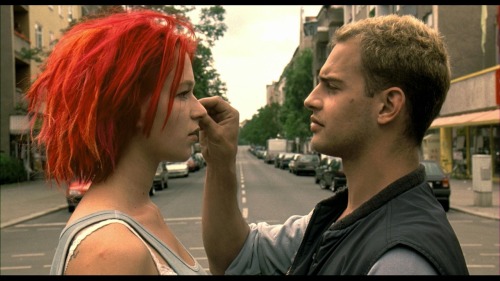
Run Lola Run

Run Lola Run is a popluar German film about a young woman named Lola who somehow needs to collect 100,000 "marks" (dollars) to her boyfriend Manny. Manny had just lost 100,000 marks that was destined for some dangerous criminal or drug lord who supposedly would have killed him if the money was not there. He is contemplating whether or not to rob a grocery store in all three of the chapters.

Now, the plot of this movie is very confusing so please bear with me... 

The film features three distinct segments or "versions" of the same scenario. In each version, Lola receives the phone call from Manny and runs towards his presence all the meanwhile trying to figure out how to attain the 100,000 marks. She only has 30 minutes, and the audience is constantly reminded of the time she has left. In the first version, Manny holds up a grocery store but in the end Lola is shot before the money could be returned. In the second episode, Lola holds up her Father at his own bank at gunpoint. Before the marks could be returned however, Manny is hit by atruck. In the final chapter, Lola wins the money at a casino and Manny regaibns his 100,000 marks from a homeless man. Also in this final version, Lola's father gets in a car wreck with the mob/gang who the money is intended for. 

After watching the entirety of Run Lola Run, it seems as though the concept of time is very relevant to German society. This is highly noticeable in one scene where Lola is one minute late to Manny, and that becomes a very overblown issue. I am still curious as to how valuable time is to Germans. Is life in Germany so structured and strictly based off the hour of the day? Is time a number on the clock, or is it more than that to German society?

In conclusion, I thought that this film was intriguing, uniqe, and distinct. I'm not really used to seeing unorthodox movies that would normally be perceived as strange, weird, or different. This movie was most certainly different, and this was because of its structure, plot, and cartoonish scenes that periodically grazed the screen. The fact that Run Lola Run is so uniqe really contributes to its popularity and its easy enjoyability. If you haven't seen this foreign film already, I highly recommend it just for its creativity.