 Of Love and Eggs is an Indonesian film that supposedly follows smaller interwoven storylines in a Jakarta working class community. The plot/s of this movie takes place during the Muslim religious holiday of Lebaran. I will assume that some of the major themes of this film might include "eggs" and "love", for they are simply mentioned in the title. Online reviews have categorized this film as being a "gentle humor" that focuses on a wide range of issues. These include parental & child relationships, Jakartan social and religious topics, and the powerful subjects of religion, love-and eggs.
 Saturday, April 23, 2011
Of Love and Eggs - Pre Thoughts
For our next film to watch in Global Film Studeies class, we will again head to Asia. To be more specific, our next foreign film in the lineup comes from a southeast Asian country that is composed of many scattered islands.
 Of Love and Eggs is an Indonesian film that supposedly follows smaller interwoven storylines in a Jakarta working class community. The plot/s of this movie takes place during the Muslim religious holiday of Lebaran. I will assume that some of the major themes of this film might include "eggs" and "love", for they are simply mentioned in the title. Online reviews have categorized this film as being a "gentle humor" that focuses on a wide range of issues. These include parental & child relationships, Jakartan social and religious topics, and the powerful subjects of religion, love-and eggs.
It will be interesting to learn how somthing so simple as an egg can be a powerful symbol in this Indonesian community and a focal point of this movie. While this movie is not a documentary, the presented footage of Of Love and Eggs should be authentic and indicative of Indonesian and Jakartan society and culture. I very much look forward to seeing this next foreign film, and be sure to stay alert for my personal analysis and synopsis of this Global Film Initiative selection.
Of Love and Eggs is an Indonesian film that supposedly follows smaller interwoven storylines in a Jakarta working class community. The plot/s of this movie takes place during the Muslim religious holiday of Lebaran. I will assume that some of the major themes of this film might include "eggs" and "love", for they are simply mentioned in the title. Online reviews have categorized this film as being a "gentle humor" that focuses on a wide range of issues. These include parental & child relationships, Jakartan social and religious topics, and the powerful subjects of religion, love-and eggs. 
Tuesday, April 12, 2011
Run Lola Run
 Run Lola Run is a popluar German film about a young woman named Lola who somehow needs to collect 100,000 "marks" (dollars) to her boyfriend Manny. Manny had just lost 100,000 marks that was destined for some dangerous criminal or drug lord who supposedly would have killed him if the money was not there. He is contemplating whether or not to rob a grocery store in all three of the chapters.
 Now, the plot of this movie is very confusing so please bear with me...
The film features three distinct segments or "versions" of the same scenario. In each version, Lola receives the phone call from Manny and runs towards his presence all the meanwhile trying to figure out how to attain the 100,000 marks. She only has 30 minutes, and the audience is constantly reminded of the time she has left. In the first version, Manny holds up a grocery store but in the end Lola is shot before the money could be returned. In the second episode, Lola holds up her Father at his own bank at gunpoint. Before the marks could be returned however, Manny is hit by atruck. In the final chapter, Lola wins the money at a casino and Manny regaibns his 100,000 marks from a homeless man. Also in this final version, Lola's father gets in a car wreck with the mob/gang who the money is intended for.
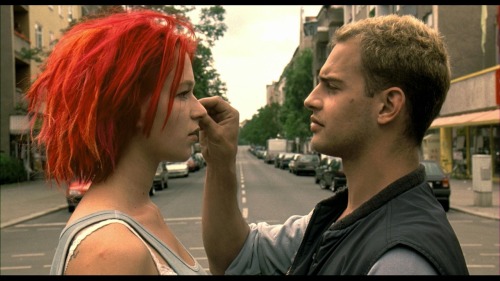 After watching the entirety of Run Lola Run, it seems as though the concept of time is very relevant to German society. This is highly noticeable in one scene where Lola is one minute late to Manny, and that becomes a very overblown issue. I am still curious as to how valuable time is to Germans. Is life in Germany so structured and strictly based off the hour of the day? Is time a number on the clock, or is it more than that to German society?
In conclusion, I thought that this film was intriguing, uniqe, and distinct. I'm not really used to seeing unorthodox movies that would normally be perceived as strange, weird, or different. This movie was most certainly different, and this was because of its structure, plot, and cartoonish scenes that periodically grazed the screen. The fact that Run Lola Run is so uniqe really contributes to its popularity and its easy enjoyability. If you haven't seen this foreign film already, I highly recommend it just for its creativity.
Hoop Dreams Essay
The film documentary Hoop Dreams concentrates its focus on the lives of two protagonists, Arthur Agee, and William Gates. Arthur and William were raised in a Chicago neighborhood notorious for its crime rate and low-income residents. The demographics of the neighborhood show that the predominant race taking residence there is African Americans. Both teenagers are passionate about basketball, and are quite good at it too. Their idol is Isaiah Thomas, who was raised in the same neighborhood and developed into a top basketball player in the NBA. The footage, which spans the four years of high school of the boys, offers the audience the truly unique experience of being witness to an extremely urban environment. The cameras follow Arthur and William as they pursue their ultimate, mutual goal: professional basketball. As we watch the documentary, the audience comes to understands how motivated these kids are, and how dedicated their lives are to the sport. Both protagonists (who we get to know well), heavily rely on their success in basketball to “take them to the top” so they can at least get out of the slums of their neighborhood. One of Chicago’s finest private schools, St. Josephs, recruits these incoming freshmen in the hope that their basketball program will make it to the state basketball championships. St. Josephs High School is located in a Chicago suburb, hours from their home on the north side of Chicago. As our two protagonists arrive for school in the predominantly white school, we see the heavy contrast with their old public school, Marshall. We see racial difference, as the boys get a glimpse of the lifestyle of middle/upper class white teenagers who attend St. Josephs. They each have their ups and downs playing basketball (William suffers an injury and Arthur transfers back to Marshall). The good news is that they both attend college on scholarships and they make it out of the neighborhood alive and well. 
 Today, Arthur and William are not playing professional basketball, however they are relatively successful. Arthur is a public speaker who discusses his rise from poverty and stresses young people to follow their dreams and goals. William graduated from Marquette University and is a real estate agent (as foreshadowed in Hoop Dreams). Although the protagonists didn’t make it to the NBA, their passion and dedication to the game of basketball let them “get away” from their problems at home and in school. They learned valuable lessons from playing the game and growing up in an urban high school.

 Today, Arthur and William are not playing professional basketball, however they are relatively successful. Arthur is a public speaker who discusses his rise from poverty and stresses young people to follow their dreams and goals. William graduated from Marquette University and is a real estate agent (as foreshadowed in Hoop Dreams). Although the protagonists didn’t make it to the NBA, their passion and dedication to the game of basketball let them “get away” from their problems at home and in school. They learned valuable lessons from playing the game and growing up in an urban high school.
 A valuable lesson is to always have a backup plan for whatever you do. Gates and Agee did not totally rely on their promotion to the NBA to give them a life. The chances of becoming a pro athlete are very slim, however if your passionate about something and you put the work in, good things will happen.
Tsotsi
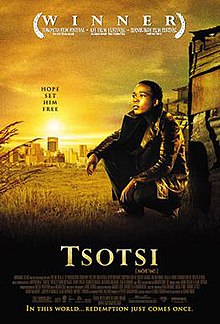 Tsotsi is a very sad, yet inspiring film. It’s about a poor teenager in South Africa who accidentally steals a car that has a baby in the backseat. He learns to take care of the baby and raise it, all the meanwhile he is in pursuit by the police. After Tsotsi gets the burden of taking care of a baby, he drops out of his gang and for the most part ends his crime-doing. Tsotsi learns a lot about life, innocence, and decency as he is looking out for the child. In the end, our protagonist decides to do the right thing and return the baby. This comes at a cost, for he must then also turn himself in.
  In South African culture, there is very much a racial divide. On one end of the spectrum we see whites living in large modern homes, and on the other there are homeless kids who sleep in cement tubes. There really never is contact between Caucasians and native Africans. This is one of those current issues that we all hope changes in the future.
This movie brings to notice the issue of apartheid, which has created so much tension in South Africa. We also get a glimpse at the extreme poverty that people in our world and our generation have to live through. The story is very touching, and for that I really enjoyed this particular foreign film.
In conclusion, the audience learns a lot about South African culture and current social state. We also come to understand the real issues that the civilians must go through. I really did like this film, and reflecting on it afterwards assisted me in my developing and analyzation process.
Chak De India!
.jpg) Chak De India is a film that deals with many issues including revenge, teamwork, discipline, and unity. A star field hockey player named Kabir Khan returns to the game after missing a penalty shot for his home country of India in the final game. Now he’s coaching a women’s team, with star players from all different regions of India. This turns out to be a challenge, because there is rivalry between players and they never understand the concept of playing for a team as one country. The Indian girls have a lot to prove, for they are always overlooked and underestimated. As the story goes, the team becomes incredibly successful and actually ends up winning the world championships in a shootout. Although the storyline is sometimes predictable, the plot is one of those “feel-good” stories.
Chak De India is a film that deals with many issues including revenge, teamwork, discipline, and unity. A star field hockey player named Kabir Khan returns to the game after missing a penalty shot for his home country of India in the final game. Now he’s coaching a women’s team, with star players from all different regions of India. This turns out to be a challenge, because there is rivalry between players and they never understand the concept of playing for a team as one country. The Indian girls have a lot to prove, for they are always overlooked and underestimated. As the story goes, the team becomes incredibly successful and actually ends up winning the world championships in a shootout. Although the storyline is sometimes predictable, the plot is one of those “feel-good” stories. Being from the U.S., I had never heard of field hockey before seeing this foreign film. In fact, I actually “googled” field hockey jut to confirm that it was a real sport. There’s a nice touch to the movie when you can say that you learned something new from watching it.
 From just watching Chak De, one can learn a lot about Indian culture. Women still do not have the same rights as males, however that is slowly changing in their society. Also, there is a huge emphasis on community and national pride. These are also cultural bridges from India to the U.S. I can personally relate to the hockey players on this women’s team for different reasons. Over the course of the movie, the team comes to understand work ethic, teamwork, and passion. These are all values that an athlete must have. Respect is another of those values that is extremely important when you’re playing a team sport.
 In conclusion, I did enjoy Chak De India! I was hoping that we would get to see an Indian film in Global Film Studies class, and luckily we did with this movie. My favorite thing about this movie is that it was based off a sports game, and it allowed me to get a better sense for a country that never really gets a lot of my attention. I must say that I am looking forward to the next movie we will be watching in class!
P.S. If you were curious at all, “Chak De India!” literally means “Go India!”
(This chant could be heard when the team was playing in the world championships)
Monday, April 11, 2011
The Host
 The Host is a South Korean horror film that was made in 2006. The plot is centered on Park Hee-bong and his two sons, daughter, and granddaughter. Their lives suddenly take a plunge (no pun intended) for the worst as a sea monster from the Han River ravages their home and takes the granddaughter in its clenched mouth. All the meanwhile, the Korean government and American military believe that this “lizard-like” monster is the host of a deadly disease. The family must go on an expedition to find the missing granddaughter while the creature and the authorities are on their tail.
In the film The Host, as audience members, we are exposed to many aspects of Korean culture. In the opening scene, we see an American chemist instruct a Korean chemist to dump a toxic substance down the drains. This turns out to be the cause for the sea monsters creation, and it leaves the American in a bad light to the viewers. We learn from this that there is a lot of resentment in Korea towards American military occupation and influence in East Asia. After watching The Host, one can somewhat understand Korean humor through the jokes that were made in the film. From my analysis, it seems as though name-calling and self-derogation are the source of Korean laughs (the movie did have its share of funny parts).
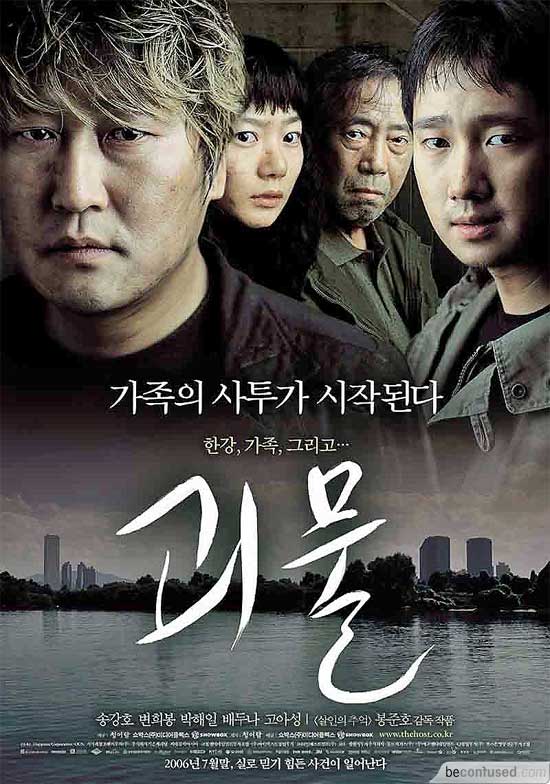 Finally, as a bonus clip to the DVD set of The Host, there is a commentary by none other than the director of the movie himself. I really found this “extra footage” to be interesting and revealing. The director spends the entire 10 to 20 minutes apologizing to absolutely anyone he can think of. I am not sure if this segment was a joke or not, but it fascinates me how respectful and incredibly nice the director was to everyone. For example, the director apologizes to actors who did not get their face viewed on screen as well as pedestrians and drivers who had transportation difficulties from filming a set. This tells me a lot about Korean ideals and values.
I can certainly make a cultural bridge between Korea and the United States. Both nations take high priority in defending their citizens if they are threatened by anyone….or anything. American military occupation in Korea means that both countries have similar militaristic interests. One last connection that can be made is that the U.S. and Korea are both pioneers and global leaders in technology, business, and production/manufacturing. I personally can relate to the many protagonists in this foreign film. They all experience their “high’s and low’s” throughout the film, something that we can all relate to. Also, I understand the feeling of struggle, loss, fear, and respect. Our cultures may be very different, but there will always be bridges to connect us.
In conclusion, I will admit that this was my favorite movie from Global Film Studies class to-date. I loved the suspense, “horror”, and overall production. It was nice to see a scary movie from a different country for once. I guess it didn’t hurt that I could make a cultural bridge from this film.
Afghan Star - Post Reaction
I just recently finished watching Afghan Star, and I rather enjoyed for its quality and its real-life issues it brings to attention.
 Our three contestant singers (and protagonists) who make it to the final stage are Habib Amiri, Setara Hussainzada, and Rafi Naabzada. Each participant comes from a different part of Afghanistan and a different tribe. While we come to expect that there will be religious tensions and rivalry, the remaining finalists plea for Afghan unity.
 As most of us know, for the past decade or so the Taliban in the Middle East has heavily constricted the rights and freedoms of civilians. Any musical or artistic expressions are illegal and subject for punishment by the governing body. When Setara dances during her final performance, she disobeys a strongly defended and supported government law.
Before you know it, Setara is running for her life as the Taliban are supposedly in close pursuit. Although we never really know what would happen if she ever did get caught by the Taliban, as viewers we usually assume the worst. Luckily for the morale of the audience, we learn that Setara becomes safe from danger as she stays in exile in the confines of a home. Meanwhile, as Afghan Star comes to its finale, it becomes understandable why this television show is so important to the Afghani people. They are all so enthralled, obsessed, and invested in the show that they completely forget about the current political and social state of their country. As the performers are being interviewed for documentary purposes, they talk about how music and singing allow them to express themselves and be happy. This is the hope for the future of Afghanistan and the Middle East.
 As a teenager living in the United States, I can certainly make a cultural bridge to Afghanistan and the protagonists in the film. To say Afghanistan and the U.S. are very different countries is not an exaggeration or overstatement. The geography, religion, political system, and society in general of the two countries are such polar-opposites right now that it’s difficult to find similarities to make connections. For one thing, Americans and Afghanis find happiness and expression through the arts. In fact, this is to say that the whole human race has this same quality/characteristic. Although I am not personally passionate about music, I find refuge in good music and I really enjoy listening to and making music as well. Also, I am very much a competitor when it comes to contests that include high stakes. The finalists all have some sort of competitive spirit in them, which in turn helps keep them stay motivated and persistent through the long campaign.
In conclusion, I learned a lot from Afghan Star and I thoroughly enjoyed the foreign film (and the performances of the contestants).
I guess the last thing I have to say is…”Keep on Rockin’ in the Free World” –Neil Young
P.S. I know the song itself doesn’t apply, but the title of it does!
Afghan Star - Pre Thoughts
 Afghan Star is a documentary that follows the course of a talent show in Afghanistan. This very popular privately funded production showcases civilian contestants performing musical acts. The talent show is televised and broadcasted all throughout the country on a weekly basis, and the performers sing for the chance at winning national fame and recognition. It might be easier to just say that Afghan Star is the Afghan version of American Idol. While you may get the impression that this film will be jolly and uplifting, there is actually a huge threat of danger that comes to the contestants and makers of this show. To really understand what is happening in this film, it will probably be necessary to update your global current events knowledge. Let’s just say that a very strict and powerful group of people called the Taliban will come into play in this film. As the “regulators” of Afghanistan, the Taliban take away civilian freedoms. This documentary shows us how a talent show is attempting to provide entertainment to the craving Afghanis who seem to live nowadays with no joy. In a deeper sense, Afghan Star is fighting back against the barriers and shackles of constrained expression that the Taliban brings upon their people. It should be interesting to find out how the show Afghan Star will affect individual lives, as well as contribute to the revival of Afghan nostalgia.
Please Vote For Me - Post Reaction
Overall, I really enjoyed watching the Chinese documentary Please Vote For Me for the last couple of days in my Global Film Studies course. Although I somewhat knew what to expect from this movie before I even saw it, I was surprised by a lot of unexpected occurrences too.
 After watching Please Vote For Me, I was surprised to notice how many similarities there are between an American 3rd grade class and that of a Chinese elementary school. Apart from the mandatory chanting-in-formation sessions the kids participated in (I had absolutely no idea what was going on in these scenes), the Chinese educational system is structured much like what I'm used to here in the United States.
Because video cameras are actually taken into the homes of Luo Lei, Xu Xaiofei, and Cheng Cheng, we are also delightfully exposed to what their personal/home lives are like. This gives us the opportunity to view and understand the daily life of a middle-class Chinese family living in an urban setting. Because China implements the "one child per family" law, it is easy to tell that parents are devoted and invested in their child's academic success. Although the parents are sometimes strict, they reassure their child when he/she goes through a tough time.
 The week-long "experiment" that was conducted brought about a lot of emotion and drama from the candidates for class president. The election campaign included alliances, betrayals, lies, backstabbing, and practically anything else you can think of (or so it seemed). In this way, the mock democracy trial was surprisingly authentic and realistic.
This foreign film brings to the surface of conversation a very interesting and debated question: Will China convert to a Democratic government in the near future? The nation is currently the only remaining global power that still operates as a communist state. Many Westerners have identified the People's Republic of China as being inhumane and neglecting towards the issue of human rights. Please Vote For Me reassures the possibility of establishing democracy in China.
In conclusion, I thoroughly enjoyed this documentary, and I was able to make plenty of cultural bridges between China and myself. I look forward to seeing new films and making new connections. Remember to follow me if you haven't already!
 After watching Please Vote For Me, I was surprised to notice how many similarities there are between an American 3rd grade class and that of a Chinese elementary school. Apart from the mandatory chanting-in-formation sessions the kids participated in (I had absolutely no idea what was going on in these scenes), the Chinese educational system is structured much like what I'm used to here in the United States.
Because video cameras are actually taken into the homes of Luo Lei, Xu Xaiofei, and Cheng Cheng, we are also delightfully exposed to what their personal/home lives are like. This gives us the opportunity to view and understand the daily life of a middle-class Chinese family living in an urban setting. Because China implements the "one child per family" law, it is easy to tell that parents are devoted and invested in their child's academic success. Although the parents are sometimes strict, they reassure their child when he/she goes through a tough time.
 The week-long "experiment" that was conducted brought about a lot of emotion and drama from the candidates for class president. The election campaign included alliances, betrayals, lies, backstabbing, and practically anything else you can think of (or so it seemed). In this way, the mock democracy trial was surprisingly authentic and realistic.
 This foreign film brings to the surface of conversation a very interesting and debated question: Will China convert to a Democratic government in the near future? The nation is currently the only remaining global power that still operates as a communist state. Many Westerners have identified the People's Republic of China as being inhumane and neglecting towards the issue of human rights. Please Vote For Me reassures the possibility of establishing democracy in China.
In conclusion, I thoroughly enjoyed this documentary, and I was able to make plenty of cultural bridges between China and myself. I look forward to seeing new films and making new connections. Remember to follow me if you haven't already!
Subscribe to:
Comments (Atom)