Monday, May 30, 2011

Kitchen Stories

Kitchen Stories is a Nowegian/Swedish film that was directed by Bent Hamer and released in the year 2003.

The plot takes place in one of the years following the end of World War 2. The setting for Kitchen Stories is in the scandinavian countryside during the winter. Swedish scientists and researchers decide to analyze kitchen use and habits of Norwegian men. This research will supposedly help Norwegian males optimize the use and utility of their home kitchen. Hundreds of Swedish observers are sent to Norway's rural communities to make note of habits and trends of Norwegian males in their kitchen. The main character, "Folke", is assigned to observe an old man named "Isak". Under pledge of the research study, Folke must remain seated in an elevated stilted chair during his month stay. He must also sit in the corner of the kitchen while taking notes & observatiosn of Isak without engaging in any verbal or physical contact with him. For the first week or so of the study, the feeling coming from the situation was of awkwardness and tension. Historically speaking, Swedes and Norwegians have disliked each other because of their differences. Stereotypes between the two have been made, and there is always unnecessary competition and hatred between people of each respective country. After a while, Isak starts opening up to Folke and they begin having conversations and meals together (against research policy rules). Before you know it, the two former rivals are quickly the best of friends. Isak's previous "best friend" is extremely jealous as a result. One day, Folke has no choice but to leave his position as researcher and head back to his home in Sweden. As soon as he can, Folke turns back towards Norway to pursue a life with Isak. To much sadness, Isak had past by the time he returned. Folke and Isak's "previous best friend" mourn their mutual pal. The final scene is of Folke and his new friend enjoying dinner together in Isak's home. There is certainly a feeling of peace and tranquility in this ending.

To put things in "Global Film Studies terms", a very strong cultural bridge can be made between Scandinavian culture/society and Midwestern USA culture/society. The Midwest has a lot of Norwegian and Swedish influence and ancestry within its population. Both the Midwest and Scandinavia are cold weathered and flat (mostly rural) land. Kitchen Stories deals with the issues of national stereotyping and rivalry. I believe every person can relate to this theme from the movie, wich is prevalent in everyday life throughout the world. The main reason I like this movie is because there are so many similarities between it and my own homeland. As I said before, a very strong and supportive cultural bridge exists between the setting of this movie and my own familiar setting.      

In my opinion, this movie was a perfect choice to analyze for Global Film Studies class. This film in particular has so many features and aspects that can be connected and associated with our lives (as the viewers). I initially thought that the basis for this movie was strange and ridiculous, however it turned out to be comedic and happily unique. I thought it was interesting that this film was largely to illustrated the Swede & Norde rivalry that exists everyday. It brought me thinking, do all Norwegian/Swedish films have to address their rivalry with one another? All I can say is that it's obviously a big  and important part of their lifestyle. One thing that I really liked about this foreign film was how similar it was to Minnesota personality and culture. In conclusion, Kitchen Stories was a slow, yet heart-lifting film that I recommend to any Midwesterner. If you can't see the correlation between this film and the Scandinavian influence here, then you  must be blind! Keep in awareness for future foreign film reviews and summaries!

Saturday, May 28, 2011

Little Otik

Little Otik is a horror film from the Czech Republic that is also known as "Greedy Guts".

A lonely middle-age couple who is infertile and unable to have their very own child is in great distress as a result. To heal his wife's sadness, the husband chops and carves a piece of wood to look like a baby, which he then gives to his her. The wife becomes extremely happy, however she grows dangerously obsessed and emotionally bonded with the figure. She begins to take care of the doll 24/7 as if it were actually a living, breathing baby of her own. She lies to her neighbors that the baby is fake, and she also keeps the wooden child from the view of her acquaintances. The husband (or father?) becomes increasingly concerned with the mental health of his wife. Then, as if you didn't see it coming, the baby becomes....ALIVE!!! While the "baby" tree carving is only portrayed in a stop-motion setting, it can perform human actions such as motion, sleeping, and eating. They decide to name the little creature "Otik", and boy can Otik eat a lot. Soon, "Little Otik" isn't so little anymore and he decides to eat pets, and even humans if there is a chance. As neighbors and friends of the couple become ever more suspicious of the family, one teenage girl discovers the truth. The girl uncovers that the life of the family and thir "Little Otik" child is actually a Czech storytale being re-told in reality. At the end of the Czech fairytale, the wooden monster had eaten many humans and grown to exteme porportions before being chopped up by an old lady. To put it briefly, this is exactly how the conclusion of the movie plays out.    

By watching this foreign film in my Global Film Studies class, I think many people had different opinions on what they thought of the movie. Sticking to our goal of making "cultural bridges", I will now mention some of the similarities and differences between Czech society/culture and American society/culture. In Little Otik, a few instances there were shown sexual images (including body parts) that would be frowned upon in the U.S. Generally, Europeans are more vocal and open on nudity and the such, and the U.S. have more strict viewing guidelines. Also, American horror films are more complex and in that they are designed to be more horrific on your emotions and your mentality, unlike Little Otik. Both countries appreciate the arts, cinemetography, and historical writings such as national fairytales and stories. Audiences of both countries can initially sympathize with the infertile couple, however only to an extent in the plot.

Overall, I really enjoyed this movie because it kept me (and the audience) on the edge of our seats. There were some humorous moments scattered in the plot, however the jokes were very dry in that they were sickening and disturbing too. Also included in this film were grotesque and certainly disturbing scenes and images. This is the only indicating factor that classified this production to the "horror" genre. I personally believe that a good horror film will keep you thinking (and fearing) about it for days afterwards. Admittedly, this was the case for meyself. For about a week, every time I went to the basement I though of the "Little Otik" and its ugly figure. Anyways, I hope this foreign film review was helpful and I highly recommend you try watching Little Otik because it was very well-made and it i an interesting look at the nature of Czech culture.    

Tuesday, May 10, 2011

The Bet Collector - Post Reaction

I have just finished watching the Filipino foreign film The Bet Collector, therefore I will now give my thoughts and opinions on the movie itself.

The Philippines do have a law against Jueteng, however the police system is corrupt and nothing ever deminishes the popular gambling game. Of this, I'm reminded of 1920 Chicago, where the Police sytem was corrupted by the notorious gangster Al Capone. 

Amy is a married "debt collector" for a Jueteng organization, who lives in a poor neighborhood in the Philippines. One of her sons had recently passed as a member of the armed forces. Her son's memory/image makes various appearences throughout the film in the form of a "ghost-like" figure. It is assumed that Amy's son is merely a memory, visiting his mother periodically in her daily life. This "ghost" does not haunt her, and Amy is fascinated and attracted to its/his presence. As Amy is doing her daily "rounds" of bet collecting, she gets caught by the police and is arrested. No worries, for she is released with only a small fine to pay. In one scene, our protagonist comes across a funeral for a 20-year-old boy who was hit by a vehicle. Memories of her son emerge, and this is a sad time of pain and reflection for Amy. Apart from the ones just mentioned, not many other significant events occur until the very end of the movie. Amy and her other son are attracted to a group of people who are crowding a dispute and heated argument between two males. One man pulls out a gun and it accidentally goes off. The bullett narowly grazes Amy's shoulder and hits her son square in the chest. This is the movie's final scene, and somehow you make sense that Amy wishes she could have taken the impact instead of her child. This is a very sad and abrubt ending to a well-made film.
There are of course many cultural bridges that can be made with this film, hypothetical and physical. Amy is like many global citizens, she works hard every day at her job in the pursuit of a better life. She puts her family before herself, and that idealogy can be understood in all corners of the earth. It now seems more clear to me than ever that gambling is a part of human nature. Humans are inclined to putting money in jeopardy in the hope for a bigger prize. Gambling can be dangerous, so people routinely get obsessed with it and are hurt by its effects. One unusual thing that caught my eye was the curious wardrobe of the Filipino children who were roaming and playing in the streets. I saw many graphic tees, sports jerseys, and brand-name shirts on the civilians of this neighborhood. This demonstrates the physical western influence on the Philippines. Also, I couldn't help but notice that Spanish had roots in the Philippine language. For example, when the bet collector called and gathered bids, the numbers that were said were in Spanish. This little quirk was very interesting to me and I'm glad I noticed it.   

In conclusion, I thought The Bet Collector was a perfect choice to watch for our Global Film Studies class. This film works out very well because we get an in-depth look at Philippine life, there are many connections to our society, and the theme of poverty is a heavy issue which everyone in the world can relate to. In addition, the movie was well directed and produced. I have no complaints. I somewhat enjoyed the ending of The Bet Collector because it was unique and unexpected. At the same time, that particular theatrical strategy can also annoy audience members because they feel cheated of the "actual" ending. I really liked this foreign film, and of course I'm always looking forward to watching more movies and blogging about them at the end. Stay tuned for more! 

Monday, May 9, 2011

The Bet Collector - Pre Thoughts

"The Bet Collector", or "Kubrador", is a Philippine foreign film that is based around the gambling game of Jueteng.

The film was made in 2006 and features amateur Philippine actors. The plot follows a protagonist, Amy, who's profession is to roam the streets and collect the bets from any locals who wish to participate in the weekly raffle. Now, the game of Jueteng is illegal in the Philippines, therefore Amelita, her family, and everyone involved in the acts of gambling are at risk for being caught. This film is highly acclaimed for its ability to give insight to a world that few people know about. To be a bet collector for a living is tough, and its important to know that this type of work is happening daily in countries like the Philippines. While this movie mainly focuses on one character, the audience gets insight and receives exposure from many different people who are going through different phases in their lives. A wide array of different themes have been associated with this film, including memory, family, and death. This film has received many Awards and nominations in the International film category.

The Bet Collector promises to be a well-made production that captures Philippine lifestyle and culture in a unique way. I personally look forward to watching this film and writing an analysis for this blog. Stay tuned for more Foreign Film Synopsis and don't forget to follow my blog!     

Saturday, May 7, 2011

Of Love and Eggs - Post Reaction

I have just recently finished watching Of Love and Eggs, a foreign film from Indonesia. Below is my personal reflections on the production and the plot of this movie.

One of the storylines is about a little boy named Bimo who lives with his brother and father in the Jakarta community which the movie takes place in. It seems as though his mother had sadly passed away, and Bimo spends the majority of his days printing stamps on eggs which are to be sold by the family business. He meets a beautiful young woman, gets emotionally connected with her, and even calls her "mother". This is much to her dissaproval. Bimo is heartbroken, however he quickly gets over himself and continues his previous ways. A totally different storyline of the film is the relationship that develops between the young woman and Bimo's older brother. They seem to get along well together, and that's all we're left with. In another scene, a short-haired young woman is furious with her father for not talking to her. She's obviously angered by her relationship with her dad, therefore they must mend overcome their differences. Despite all these stories happening, all the meanwhile the community needs a new decoration for the roof of their place of worship. In the end, this essentiality is delivered and the community members are delighted and grateful.


After watching any film, I develop a personal opinion on my overall viewing experience. To be completely honest, Of Love and Eggs was simply "mediocre" in my eyes. I would not consider the movie bad (it takes a lot for me to hate a movie), however I was not satisfied with the foreign production. The plot was quite slow, uninteresting, and difficult to follow at most times due to the many inter-weaving storylines that were happening continuously. I know that I don't speak for every viewer, however I did notice that when I glanced around the classroom that most students were "dozing off" or staring blankly at the screen with their heads on their hands. Perhaps the problem is not the movie, but simply our inability to connect and relate to Indonesian cinemetography. This is when the cultural differences begin to arise. Indonesian media arts are so different from our "normality" that we can't find correlations which in effect would gather our interest.

In conclusion, Of Love and Eggs was not a great movie and I wouldn't recommend it (unless you're in a tired, calm, and patient mood). This analysis does not reflect the intentions of the director. I believe the movie is really meant to be uplifting and bright, therefore I have respect for that effort and task. On a high note, the plot did not lack humor and there were some well-done scenes. In particular, the scenes with the deaf child were touching. She's attempting to sing, unfortunately she can't hear herself; these were sad scenes. I look forward to enjoying more notable foreign films in my upcoming classes. There is a good lineup of movies coming up, and I will be sure to continue uploading my synopsis of those on this blog.  

Saturday, April 23, 2011

Of Love and Eggs - Pre Thoughts

For our next film to watch in Global Film Studeies class, we will again head to Asia. To be more specific, our next foreign film in the lineup comes from a southeast Asian country that is composed of many scattered islands.

Of Love and Eggs is an Indonesian film that supposedly follows smaller interwoven storylines in a Jakarta working class community. The plot/s of this movie takes place during the Muslim religious holiday of Lebaran. I will assume that some of the major themes of this film might include "eggs" and "love", for they are simply mentioned in the title. Online reviews have categorized this film as being a "gentle humor" that focuses on a wide range of issues. These include parental & child relationships, Jakartan social and religious topics, and the powerful subjects of religion, love-and eggs.

It will be interesting to learn how somthing so simple as an egg can be a powerful symbol in this Indonesian community and a focal point of this movie. While this movie is not a documentary, the presented footage of Of Love and Eggs should be authentic and indicative of Indonesian and Jakartan society and culture. I very much look forward to seeing this next foreign film, and be sure to stay alert for my personal analysis and synopsis of this Global Film Initiative selection.

Tuesday, April 12, 2011

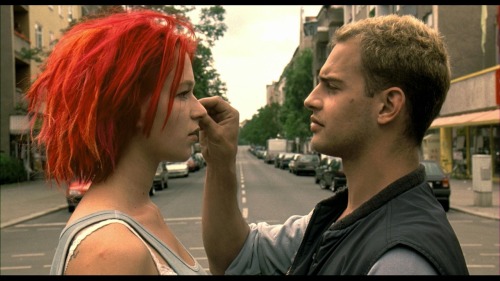
Run Lola Run

Run Lola Run is a popluar German film about a young woman named Lola who somehow needs to collect 100,000 "marks" (dollars) to her boyfriend Manny. Manny had just lost 100,000 marks that was destined for some dangerous criminal or drug lord who supposedly would have killed him if the money was not there. He is contemplating whether or not to rob a grocery store in all three of the chapters.

Now, the plot of this movie is very confusing so please bear with me... 

The film features three distinct segments or "versions" of the same scenario. In each version, Lola receives the phone call from Manny and runs towards his presence all the meanwhile trying to figure out how to attain the 100,000 marks. She only has 30 minutes, and the audience is constantly reminded of the time she has left. In the first version, Manny holds up a grocery store but in the end Lola is shot before the money could be returned. In the second episode, Lola holds up her Father at his own bank at gunpoint. Before the marks could be returned however, Manny is hit by atruck. In the final chapter, Lola wins the money at a casino and Manny regaibns his 100,000 marks from a homeless man. Also in this final version, Lola's father gets in a car wreck with the mob/gang who the money is intended for. 

After watching the entirety of Run Lola Run, it seems as though the concept of time is very relevant to German society. This is highly noticeable in one scene where Lola is one minute late to Manny, and that becomes a very overblown issue. I am still curious as to how valuable time is to Germans. Is life in Germany so structured and strictly based off the hour of the day? Is time a number on the clock, or is it more than that to German society?

In conclusion, I thought that this film was intriguing, uniqe, and distinct. I'm not really used to seeing unorthodox movies that would normally be perceived as strange, weird, or different. This movie was most certainly different, and this was because of its structure, plot, and cartoonish scenes that periodically grazed the screen. The fact that Run Lola Run is so uniqe really contributes to its popularity and its easy enjoyability. If you haven't seen this foreign film already, I highly recommend it just for its creativity. 

Hoop Dreams Essay

The film documentary Hoop Dreams concentrates its focus on the lives of two protagonists, Arthur Agee, and William Gates. Arthur and William were raised in a Chicago neighborhood notorious for its crime rate and low-income residents. The demographics of the neighborhood show that the predominant race taking residence there is African Americans. Both teenagers are passionate about basketball, and are quite good at it too. Their idol is Isaiah Thomas, who was raised in the same neighborhood and developed into a top basketball player in the NBA. The footage, which spans the four years of high school of the boys, offers the audience the truly unique experience of being witness to an extremely urban environment. The cameras follow Arthur and William as they pursue their ultimate, mutual goal: professional basketball. As we watch the documentary, the audience comes to understands how motivated these kids are, and how dedicated their lives are to the sport. Both protagonists (who we get to know well), heavily rely on their success in basketball to “take them to the top” so they can at least get out of the slums of their neighborhood. One of Chicago’s finest private schools, St. Josephs, recruits these incoming freshmen in the hope that their basketball program will make it to the state basketball championships. St. Josephs High School is located in a Chicago suburb, hours from their home on the north side of Chicago. As our two protagonists arrive for school in the predominantly white school, we see the heavy contrast with their old public school, Marshall. We see racial difference, as the boys get a glimpse of the lifestyle of middle/upper class white teenagers who attend St. Josephs. They each have their ups and downs playing basketball (William suffers an injury and Arthur transfers back to Marshall). The good news is that they both attend college on scholarships and they make it out of the neighborhood alive and well.
Today, Arthur and William are not playing professional basketball, however they are relatively successful. Arthur is a public speaker who discusses his rise from poverty and stresses young people to follow their dreams and goals. William graduated from Marquette University and is a real estate agent (as foreshadowed in Hoop Dreams). Although the protagonists didn’t make it to the NBA, their passion and dedication to the game of basketball let them “get away” from their problems at home and in school. They learned valuable lessons from playing the game and growing up in an urban high school. 
A valuable lesson is to always have a backup plan for whatever you do. Gates and Agee did not totally rely on their promotion to the NBA to give them a life. The chances of becoming a pro athlete are very slim, however if your passionate about something and you put the work in, good things will happen.

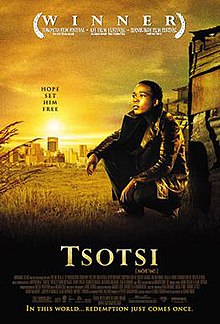
Tsotsi

Tsotsi is a very sad, yet inspiring film. It’s about a poor teenager in South Africa who accidentally steals a car that has a baby in the backseat. He learns to take care of the baby and raise it, all the meanwhile he is in pursuit by the police. After Tsotsi gets the burden of taking care of a baby, he drops out of his gang and for the most part ends his crime-doing. Tsotsi learns a lot about life, innocence, and decency as he is looking out for the child. In the end, our protagonist decides to do the right thing and return the baby. This comes at a cost, for he must then also turn himself in.   
In South African culture, there is very much a racial divide. On one end of the spectrum we see whites living in large modern homes, and on the other there are homeless kids who sleep in cement tubes. There really never is contact between Caucasians and native Africans. This is one of those current issues that we all hope changes in the future.
This movie brings to notice the issue of apartheid, which has created so much tension in South Africa. We also get a glimpse at the extreme poverty that people in our world and our generation have to live through. The story is very touching, and for that I really enjoyed this particular foreign film.  
In conclusion, the audience learns a lot about South African culture and current social state. We also come to understand the real issues that the civilians must go through. I really did like this film, and reflecting on it afterwards assisted me in my developing and analyzation process.

Chak De India!

Chak De India is a film that deals with many issues including revenge, teamwork, discipline, and unity. A star field hockey player named Kabir Khan returns to the game after missing a penalty shot for his home country of India in the final game. Now he’s coaching a women’s team, with star players from all different regions of India. This turns out to be a challenge, because there is rivalry between players and they never understand the concept of playing for a team as one country. The Indian girls have a lot to prove, for they are always overlooked and underestimated. As the story goes, the team becomes incredibly successful and actually ends up winning the world championships in a shootout.  Although the storyline is sometimes predictable, the plot is one of those “feel-good” stories.
Being from the U.S., I had never heard of field hockey before seeing this foreign film. In fact, I actually “googled” field hockey jut to confirm that it was a real sport. There’s a nice touch to the movie when you can say that you learned something new from watching it.
From just watching Chak De, one can learn a lot about Indian culture. Women still do not have the same rights as males, however that is slowly changing in their society. Also, there is a huge emphasis on community and national pride. These are also cultural bridges from India to the U.S. I can personally relate to the hockey players on this women’s team for different reasons. Over the course of the movie, the team comes to understand work ethic, teamwork, and passion. These are all values that an athlete must have. Respect is another of those values that is extremely important when you’re playing a team sport.  
In conclusion, I did enjoy Chak De India! I was hoping that we would get to see an Indian film in Global Film Studies class, and luckily we did with this movie. My favorite thing about this movie is that it was based off a sports game, and it allowed me to get a better sense for a country that never really gets a lot of my attention. I must say that I am looking forward to the next movie we will be watching in class!
P.S. If you were curious at all, “Chak De India!” literally means “Go India!”
(This chant could be heard when the team was playing in the world championships)

Monday, April 11, 2011

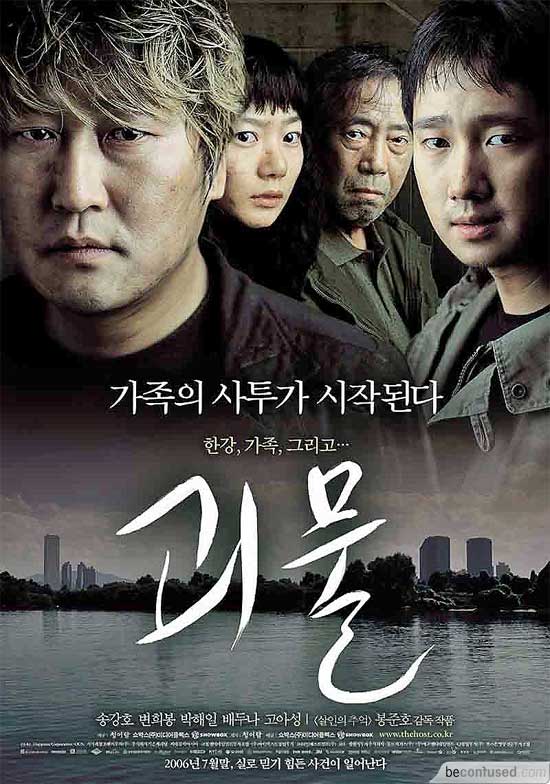
The Host

The Host is a South Korean horror film that was made in 2006. The plot is centered on Park Hee-bong and his two sons, daughter, and granddaughter. Their lives suddenly take a plunge (no pun intended) for the worst as a sea monster from the Han River ravages their home and takes the granddaughter in its clenched mouth. All the meanwhile, the Korean government and American military believe that this “lizard-like” monster is the host of a deadly disease. The family must go on an expedition to find the missing granddaughter while the creature and the authorities are on their tail.
In the film The Host, as audience members, we are exposed to many aspects of Korean culture. In the opening scene, we see an American chemist instruct a Korean chemist to dump a toxic substance down the drains. This turns out to be the cause for the sea monsters creation, and it leaves the American in a bad light to the viewers. We learn from this that there is a lot of resentment in Korea towards American military occupation and influence in East Asia. After watching The Host, one can somewhat understand Korean humor through the jokes that were made in the film. From my analysis, it seems as though name-calling and self-derogation are the source of Korean laughs (the movie did have its share of funny parts).
Finally, as a bonus clip to the DVD set of The Host, there is a commentary by none other than the director of the movie himself. I really found this “extra footage” to be interesting and revealing. The director spends the entire 10 to 20 minutes apologizing to absolutely anyone he can think of. I am not sure if this segment was a joke or not, but it fascinates me how respectful and incredibly nice the director was to everyone.  For example, the director apologizes to actors who did not get their face viewed on screen as well as pedestrians and drivers who had transportation difficulties from filming a set. This tells me a lot about Korean ideals and values.
I can certainly make a cultural bridge between Korea and the United States. Both nations take high priority in defending their citizens if they are threatened by anyone….or anything. American military occupation in Korea means that both countries have similar militaristic interests. One last connection that can be made is that the U.S. and Korea are both pioneers and global leaders in technology, business, and production/manufacturing. I personally can relate to the many protagonists in this foreign film. They all experience their “high’s and low’s” throughout the film, something that we can all relate to. Also, I understand the feeling of struggle, loss, fear, and respect. Our cultures may be very different, but there will always be bridges to connect us.  
In conclusion, I will admit that this was my favorite movie from Global Film Studies class to-date. I loved the suspense, “horror”, and overall production. It was nice to see a scary movie from a different country for once. I guess it didn’t hurt that I could make a cultural bridge from this film.

Afghan Star - Post Reaction

I just recently finished watching Afghan Star, and I rather enjoyed for its quality and its real-life issues it brings to attention.
Our three contestant singers (and protagonists) who make it to the final stage are Habib Amiri, Setara Hussainzada, and Rafi Naabzada. Each participant comes from a different part of Afghanistan and a different tribe. While we come to expect that there will be religious tensions and rivalry, the remaining finalists plea for Afghan unity.
As most of us know, for the past decade or so the Taliban in the Middle East has heavily constricted the rights and freedoms of civilians. Any musical or artistic expressions are illegal and subject for punishment by the governing body. When Setara dances during her final performance, she disobeys a strongly defended and supported government law.
Before you know it, Setara is running for her life as the Taliban are supposedly in close pursuit. Although we never really know what would happen if she ever did get caught by the Taliban, as viewers we usually assume the worst.  Luckily for the morale of the audience, we learn that Setara becomes safe from danger as she stays in exile in the confines of a home. Meanwhile, as Afghan Star comes to its finale, it becomes understandable why this television show is so important to the Afghani people. They are all so enthralled, obsessed, and invested in the show that they completely forget about the current political and social state of their country. As the performers are being interviewed for documentary purposes, they talk about how music and singing allow them to express themselves and be happy. This is the hope for the future of Afghanistan and the Middle East.
As a teenager living in the United States, I can certainly make a cultural bridge to Afghanistan and the protagonists in the film. To say Afghanistan and the U.S. are very different countries is not an exaggeration or overstatement. The geography, religion, political system, and society in general of the two countries are such polar-opposites right now that it’s difficult to find similarities to make connections. For one thing, Americans and Afghanis find happiness and expression through the arts. In fact, this is to say that the whole human race has this same quality/characteristic. Although I am not personally passionate about music, I find refuge in good music and I really enjoy listening to and making music as well. Also, I am very much a competitor when it comes to contests that include high stakes. The finalists all have some sort of competitive spirit in them, which in turn helps keep them stay motivated and persistent through the long campaign.
In conclusion, I learned a lot from Afghan Star and I thoroughly enjoyed the foreign film (and the performances of the contestants).
I guess the last thing I have to say is…”Keep on Rockin’ in the Free World” –Neil Young
P.S. I know the song itself doesn’t apply, but the title of it does!

Afghan Star - Pre Thoughts

Afghan Star is a documentary that follows the course of a talent show in Afghanistan. This very popular privately funded production showcases civilian contestants performing musical acts. The talent show is televised and broadcasted all throughout the country on a weekly basis, and the performers sing for the chance at winning national fame and recognition. It might be easier to just say that Afghan Star is the Afghan version of American Idol. While you may get the impression that this film will be jolly and uplifting, there is actually a huge threat of danger that comes to the contestants and makers of this show. To really understand what is happening in this film, it will probably be necessary to update your global current events knowledge. Let’s just say that a very strict and powerful group of people called the Taliban will come into play in this film. As the “regulators” of Afghanistan, the Taliban take away civilian freedoms. This documentary shows us how a talent show is attempting to provide entertainment to the craving Afghanis who seem to live nowadays with no joy. In a deeper sense, Afghan Star is fighting back against the barriers and shackles of constrained expression that the Taliban brings upon their people. It should be interesting to find out how the show Afghan Star will affect individual lives, as well as contribute to the revival of Afghan nostalgia.

Please Vote For Me - Post Reaction

Overall, I really enjoyed watching the Chinese documentary Please Vote For Me for the last couple of days in my Global Film Studies course. Although I somewhat knew what to expect from this movie before I even saw it, I was surprised by a lot of unexpected occurrences too.

After watching Please Vote For Me, I was surprised to notice how many similarities there are between an American 3rd grade class and that of a Chinese elementary school. Apart from the mandatory chanting-in-formation sessions the kids participated in (I had absolutely no idea what was going on in these scenes), the Chinese educational system is structured much like what I'm used to here in the United States.

Because video cameras are actually taken into the homes of Luo Lei, Xu Xaiofei, and Cheng Cheng, we are also delightfully exposed to what their personal/home lives are like. This gives us the opportunity to view and understand the daily life of a middle-class Chinese family living in an urban setting. Because China implements the "one child per family" law, it is easy to tell that parents are devoted and invested in their child's academic success. Although the parents are sometimes strict, they reassure their child when he/she goes through a tough time.

The week-long "experiment" that was conducted brought about a lot of emotion and drama from the candidates for class president. The election campaign included alliances, betrayals, lies, backstabbing, and practically anything else you can think of (or so it seemed). In this way, the mock democracy trial was surprisingly authentic and realistic.

This foreign film brings to the surface of conversation a very interesting and debated question: Will China convert to a Democratic government in the near future? The nation is currently the only remaining global power that still operates as a communist state. Many Westerners have identified the People's Republic of China as being inhumane and neglecting towards the issue of human rights. Please Vote For Me reassures the possibility of establishing democracy in China.

In conclusion, I thoroughly enjoyed this documentary, and I was able to make plenty of cultural bridges between China and myself. I look forward to seeing new films and making new connections. Remember to follow me if you haven't already!

Monday, March 7, 2011

Please Vote For Me - Pre Thoughts

Please Vote For Me is a 2007 Chinese documentery set in an elementary school in Wuhan, China. Supposedly, the documentary is about the introduction of Democracy to a class of 3rd graders. Modern China, of course, is a Communist nation; this means that the government is led by a single party state and no public voting occurs. The idea of this film is quite interesting because I have never heard of anything like this ever happening or taking place. It's almost as if the producers of this film are "experimenting" a whole new political system on these kids for a week. In Please Vote For Me, three randomly selected students become candidates and must capaign themselves to win over the votes of their classmates. I think I'm really going to enjoy seeing how this film progresses. My main question is, "Is this idea actually going to work?". This is the perfect foreign film to allow me to make a cultural bridge. I know a sufficient amount of basic and general information about China already, but I think Please Vote For Me is going to expose me to even more of an understanding of China and it's communistic political system and government. I look forward to blogging about this film after I have finished watching it!

Thursday, February 24, 2011

Mongolian Ping Pong - Post Reaction

My Global Film Studies class has just finished Mongolian Ping Pong, and overall I was pretty satisfied with the film.

The plot is centered around one little boy, Bilike, and his friends Erguotou and Dawa. They all live in the remote grasslands of Mongolia where they herd sheep and live simple lives. There is no technology, and as one might expect there is a huge emphasis on community and family. One day, Bilike comes across a round, white object in the stream. It was obvious that the object was a ping pong ball, however Bilike and his friends assumed it was a "magic pearl that glowed". They prized and treasured that ball for a very long time, all the meanwhile trying to figure out its origins. The boys even try consulting the village leaders, but even they did not know what the mysterious ball was, or where came from. In a slightly humorous scene, the trio visit the wise monks to ask the question, what is this object and where did it come from? The lamas are stumped too. One day, Bilike, Erguotou, and Dawa discover the game of ping pong on Dawa's fathers television set. Somehow the boys believe the ball is the "national ball" of China, so they attempt to journey to Beijing to "return it". In what was a likely scenario, the friends don't get an hour out before they realize the destination is too far for them. When all hope seems lost, something truly miraculous happens! My favorite scene is the ending, when Bilike walks into a "rec center" and hears the noive of bouncing objects in the next room. He opens the door to investigate and ..... a look of astonishment comes on his face.

One strong contrast between Mongolian films and American films is the humor. In many instances throughout the video, the actors stare blankly at a person, event, or visual attraction of some sort. Sometimes these moments last beyond their effect on the audience. Where these moments intended to be funny? It's hard to tell.

The actors in Mongolian Ping Pong were excellent in my opinion, and the production and direction were also above my initail expectations. The actors were so convincing that I admit I thought the film was a documentary for the first 20 minutes or so!. I must add that the Mongolia grassland scenery is very majestic and beautiful. The setting and environment seems so relexing and peaceful. The people of the grasslands are respectful, nice, and always in good mood. I am starting to realize that Mongolian Ping Pong has actually created a cultural bridge for me. I look forward to crossing more cultural bridges! 

Mongolian Ping Pong - Pre Thoughts

This week in Global Film Studies class we are going to be watching Mongolian Ping Pong. Apparently this film is centered around a little mongolian boy who comes across a ping pong ball, and decides to journey to find its origins. One thing that I love about these foreign films so far is that the main idea's are nothing close to "cookie-cutter". They are original, creative prompts that one would never expect to see in a movie. I was slightly skeptical about "The Weeping Camel" because I did not believe the plot could hold strong throughout the entirety of the film. Let's just say I know better this time. I admit the plot seems lacking and simple, but that's part of what makes the film unique, different, and in it's own way, interesting. The last Mongolian film I saw was excellent in my opinion, so I certainly have high expectations for the upcoming masterpiece.

You know, you can learn a lot about a film even before viewing any of its content. I like to briefly analyze the cover image out of curiosity and for the purpose of knowing what to expect. The Mongolian scenery is truly breathtaking and spectacular, and it appears as though modern civilization hasn't interfered at all. The setting looks to be the countryside, where there would be absolutely no running water or electricity. The grassland would be home to many animals, and I assume children would be forced into developing strong creativity to pass the time.

That's all I have to say for now, but stay tuned for my reflection on Mongolian Ping Pong after I have seen the film!

Sunday, February 20, 2011

The Weeping Camel - Post Reaction

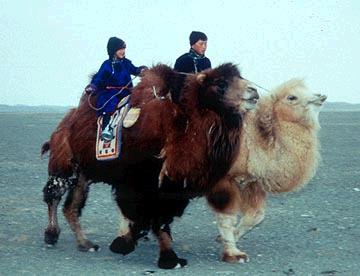
The Story of the Weeping Camel is a Mongolian documentary made in 2003. This film is centered around a family of nomadic animal shepherds who live in the Gobi Desert of Mongolia.

The story of the weeping camel begins with a mother camel who is about to give birth. After an excruciatingly long labor period, the mother gives birth to a strong, healthy calf. This is no ordinary calf however, for the newly-born camel is albino (completely white of color). This outcome is extremely rare and unlikely in the natural world, and the mother camel seems very disapproving with her child. The calf is rejected of love and its mothers milk. This is a serious problem for the Mongolian family because the camels need to establish a strong relationship so the baby can be nurtured and cared for.
The family concludes that a ritual ceremony must take place to allow the mother camel to accept her child. Two young boys, Ugna & Dude must travel via camelback to the local village/city to hire a violinist for the ceremony. The violinist is an essential part of the ritual process. The musician is brought back to the campsite, where there always seems to be a strong emphasis on community and family bonding.

The film reaches a "climax" when the ritual takes place. As the mother camel in consoled, beautiful singing  is accompanied with a violin song in a traditional Mongolian folk song. In what is a very emotional ending, the mother camel literally weeps, as tears are clearly visible coming from her eyes. To be honest, I didn't even know a camel (or any other animal for that matter) could cry. In what struck me as a miracle, the mother camel and her calf are all of a sudden emotionally bonded. This is proved when the mother camel finally allows her calf to take her milk. The family celebrates, and soon after, life for them returns to normal.

There are a lot of things about this foreign film that I found interesting. The contrast between the Mongolian lifestyle and my own is very strong. They live simple lives and survive off of what they own, meanwhile I have an abundance of unnecessary possessions. While Ugna and Dude were on their trek, I really got a sense for how the mongolian landscape was. The countryside is practically desert - extremely remote and vast with very little in terms of modern amenities and civilization. Myself, I live in an urban environment that has a dense population. All my necessities are within a couple of miles, and I can be transported easily by car or bus. I'm still unsre as to whether this film is documentary or fiction, but overall it was really well made and directed. I understand that my Global Film Studies class is about making cultural bridges, and I certainly think this film did just that for me.

The Weeping Camel - Pre Thoughts

This week in Global Film Studies class we will be watching a Mongolian foreign film called "The Story of the Weeping Camel". I have never really "scene" a foreign film before, so I am pretty excited to be exposed to something with more of a global and international flavor. I really don't know that much about the country of Mongolia, however I do know that it is a rural and remote country that lies between China and Russia. 

I am slightly skeptic about that this film can maintain a plot based solely on a camel. What does it's ability to cry have to do with anything? Why is a camel crying in the first place? I am interested in what the plot will be about, and I look forward to making a "cultural bridge" between the society of Mongolia and myself. I believe that by watching this movie, many of my questions will become answers.I guess i'm just going to have to watch "The Weeping Camel" to find out what its all about!