The Story of the Weeping Camel is a Mongolian documentary made in 2003. This film is centered around a family of nomadic animal shepherds who live in the Gobi Desert of Mongolia.
 The story of the weeping camel begins with a mother camel who is about to give birth. After an excruciatingly long labor period, the mother gives birth to a strong, healthy calf. This is no ordinary calf however, for the newly-born camel is albino (completely white of color). This outcome is extremely rare and unlikely in the natural world, and the mother camel seems very disapproving with her child. The calf is rejected of love and its mothers milk. This is a serious problem for the Mongolian family because the camels need to establish a strong relationship so the baby can be nurtured and cared for.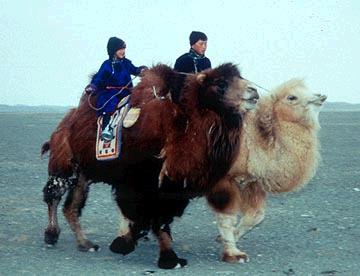
The family concludes that a ritual ceremony must take place to allow the mother camel to accept her child. Two young boys, Ugna & Dude must travel via camelback to the local village/city to hire a violinist for the ceremony. The violinist is an essential part of the ritual process. The musician is brought back to the campsite, where there always seems to be a strong emphasis on community and family bonding.
The film reaches a "climax" when the ritual takes place. As the mother camel in consoled, beautiful singing is accompanied with a violin song in a traditional Mongolian folk song. In what is a very emotional ending, the mother camel literally weeps, as tears are clearly visible coming from her eyes. To be honest, I didn't even know a camel (or any other animal for that matter) could cry. In what struck me as a miracle, the mother camel and her calf are all of a sudden emotionally bonded. This is proved when the mother camel finally allows her calf to take her milk. The family celebrates, and soon after, life for them returns to normal.
 There are a lot of things about this foreign film that I found interesting. The contrast between the Mongolian lifestyle and my own is very strong. They live simple lives and survive off of what they own, meanwhile I have an abundance of unnecessary possessions. While Ugna and Dude were on their trek, I really got a sense for how the mongolian landscape was. The countryside is practically desert - extremely remote and vast with very little in terms of modern amenities and civilization. Myself, I live in an urban environment that has a dense population. All my necessities are within a couple of miles, and I can be transported easily by car or bus. I'm still unsre as to whether this film is documentary or fiction, but overall it was really well made and directed. I understand that my Global Film Studies class is about making cultural bridges, and I certainly think this film did just that for me.
No comments:
Post a Comment