Thursday, February 24, 2011

Mongolian Ping Pong - Post Reaction

My Global Film Studies class has just finished Mongolian Ping Pong, and overall I was pretty satisfied with the film.

The plot is centered around one little boy, Bilike, and his friends Erguotou and Dawa. They all live in the remote grasslands of Mongolia where they herd sheep and live simple lives. There is no technology, and as one might expect there is a huge emphasis on community and family. One day, Bilike comes across a round, white object in the stream. It was obvious that the object was a ping pong ball, however Bilike and his friends assumed it was a "magic pearl that glowed". They prized and treasured that ball for a very long time, all the meanwhile trying to figure out its origins. The boys even try consulting the village leaders, but even they did not know what the mysterious ball was, or where came from. In a slightly humorous scene, the trio visit the wise monks to ask the question, what is this object and where did it come from? The lamas are stumped too. One day, Bilike, Erguotou, and Dawa discover the game of ping pong on Dawa's fathers television set. Somehow the boys believe the ball is the "national ball" of China, so they attempt to journey to Beijing to "return it". In what was a likely scenario, the friends don't get an hour out before they realize the destination is too far for them. When all hope seems lost, something truly miraculous happens! My favorite scene is the ending, when Bilike walks into a "rec center" and hears the noive of bouncing objects in the next room. He opens the door to investigate and ..... a look of astonishment comes on his face.

One strong contrast between Mongolian films and American films is the humor. In many instances throughout the video, the actors stare blankly at a person, event, or visual attraction of some sort. Sometimes these moments last beyond their effect on the audience. Where these moments intended to be funny? It's hard to tell.

The actors in Mongolian Ping Pong were excellent in my opinion, and the production and direction were also above my initail expectations. The actors were so convincing that I admit I thought the film was a documentary for the first 20 minutes or so!. I must add that the Mongolia grassland scenery is very majestic and beautiful. The setting and environment seems so relexing and peaceful. The people of the grasslands are respectful, nice, and always in good mood. I am starting to realize that Mongolian Ping Pong has actually created a cultural bridge for me. I look forward to crossing more cultural bridges! 

Mongolian Ping Pong - Pre Thoughts

This week in Global Film Studies class we are going to be watching Mongolian Ping Pong. Apparently this film is centered around a little mongolian boy who comes across a ping pong ball, and decides to journey to find its origins. One thing that I love about these foreign films so far is that the main idea's are nothing close to "cookie-cutter". They are original, creative prompts that one would never expect to see in a movie. I was slightly skeptical about "The Weeping Camel" because I did not believe the plot could hold strong throughout the entirety of the film. Let's just say I know better this time. I admit the plot seems lacking and simple, but that's part of what makes the film unique, different, and in it's own way, interesting. The last Mongolian film I saw was excellent in my opinion, so I certainly have high expectations for the upcoming masterpiece.

You know, you can learn a lot about a film even before viewing any of its content. I like to briefly analyze the cover image out of curiosity and for the purpose of knowing what to expect. The Mongolian scenery is truly breathtaking and spectacular, and it appears as though modern civilization hasn't interfered at all. The setting looks to be the countryside, where there would be absolutely no running water or electricity. The grassland would be home to many animals, and I assume children would be forced into developing strong creativity to pass the time.

That's all I have to say for now, but stay tuned for my reflection on Mongolian Ping Pong after I have seen the film!

Sunday, February 20, 2011

The Weeping Camel - Post Reaction

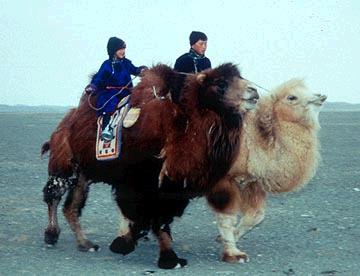
The Story of the Weeping Camel is a Mongolian documentary made in 2003. This film is centered around a family of nomadic animal shepherds who live in the Gobi Desert of Mongolia.

The story of the weeping camel begins with a mother camel who is about to give birth. After an excruciatingly long labor period, the mother gives birth to a strong, healthy calf. This is no ordinary calf however, for the newly-born camel is albino (completely white of color). This outcome is extremely rare and unlikely in the natural world, and the mother camel seems very disapproving with her child. The calf is rejected of love and its mothers milk. This is a serious problem for the Mongolian family because the camels need to establish a strong relationship so the baby can be nurtured and cared for.
The family concludes that a ritual ceremony must take place to allow the mother camel to accept her child. Two young boys, Ugna & Dude must travel via camelback to the local village/city to hire a violinist for the ceremony. The violinist is an essential part of the ritual process. The musician is brought back to the campsite, where there always seems to be a strong emphasis on community and family bonding.

The film reaches a "climax" when the ritual takes place. As the mother camel in consoled, beautiful singing  is accompanied with a violin song in a traditional Mongolian folk song. In what is a very emotional ending, the mother camel literally weeps, as tears are clearly visible coming from her eyes. To be honest, I didn't even know a camel (or any other animal for that matter) could cry. In what struck me as a miracle, the mother camel and her calf are all of a sudden emotionally bonded. This is proved when the mother camel finally allows her calf to take her milk. The family celebrates, and soon after, life for them returns to normal.

There are a lot of things about this foreign film that I found interesting. The contrast between the Mongolian lifestyle and my own is very strong. They live simple lives and survive off of what they own, meanwhile I have an abundance of unnecessary possessions. While Ugna and Dude were on their trek, I really got a sense for how the mongolian landscape was. The countryside is practically desert - extremely remote and vast with very little in terms of modern amenities and civilization. Myself, I live in an urban environment that has a dense population. All my necessities are within a couple of miles, and I can be transported easily by car or bus. I'm still unsre as to whether this film is documentary or fiction, but overall it was really well made and directed. I understand that my Global Film Studies class is about making cultural bridges, and I certainly think this film did just that for me.

The Weeping Camel - Pre Thoughts

This week in Global Film Studies class we will be watching a Mongolian foreign film called "The Story of the Weeping Camel". I have never really "scene" a foreign film before, so I am pretty excited to be exposed to something with more of a global and international flavor. I really don't know that much about the country of Mongolia, however I do know that it is a rural and remote country that lies between China and Russia. 

I am slightly skeptic about that this film can maintain a plot based solely on a camel. What does it's ability to cry have to do with anything? Why is a camel crying in the first place? I am interested in what the plot will be about, and I look forward to making a "cultural bridge" between the society of Mongolia and myself. I believe that by watching this movie, many of my questions will become answers.I guess i'm just going to have to watch "The Weeping Camel" to find out what its all about!